11 min read
2026/11/19
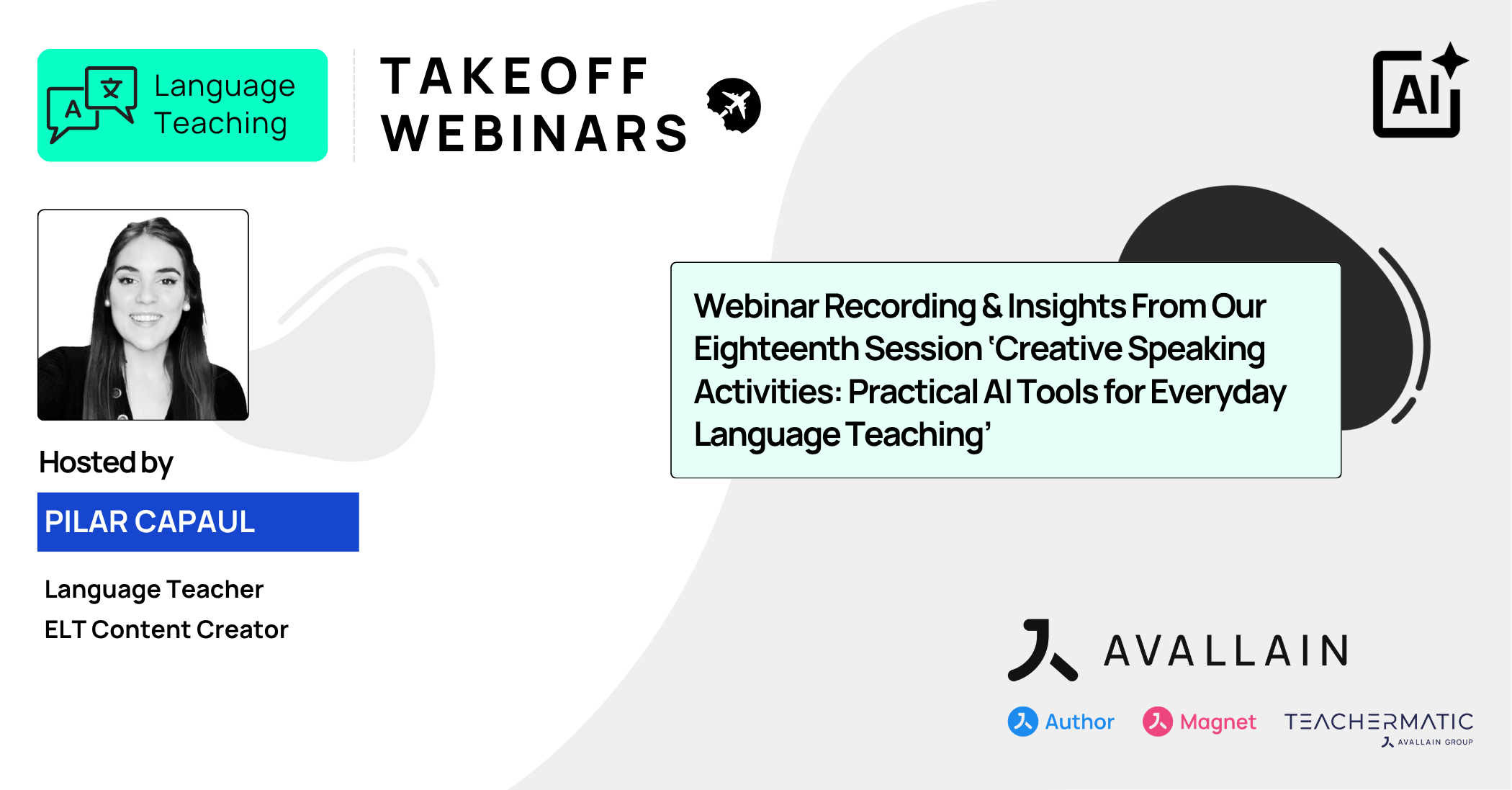
Hosted by Pilar Capaul, language teacher and ELT content creator, the latest Language Teaching Takeoff Webinar explored how teachers can create engaging, communicative speaking activities with TeacherMatic for Language Teaching.
Build Learner Confidence and Speaking Skills with Creative, Safe AI Activities
London, November 2026 – In ‘Creative Speaking Activities: Practical AI Tools for Everyday Language Teaching’, Pilar reflected on the challenges of encouraging learners to speak during lessons and demonstrated how teachers can use TeacherMatic’s ‘Act it out’ and ‘Information-gap role play’ generators to develop realistic scenarios, contextualise language practice and introduce more engaging and fun speaking opportunities into their lessons.
Moderated by Alba Melián, Marketing and Sales Operations Consultant at Avallain, the session drew on Pilar’s classroom experience, highlighting the variety of scenarios and creative possibilities the generators offer while keeping the teacher at the centre of learning.
Creating Speaking Opportunities with TeacherMatic
Pilar acknowledged that encouraging learners to speak and participate in class isn’t always easy. Finding creative ways to engage students and develop meaningful speaking activities can be equally challenging.
Performances and role plays offer opportunities to practise language in context, build confidence and encourage collaboration. However, as Pilar pointed out, teachers aren’t professional playwrights.
Through the use of safe and ethical AI tools, TeacherMatic for Language Teaching can support this creative process. With an easy-to-navigate dashboard and a range of purpose-built AI generators, teachers can develop engaging activities tailored to their learners’ needs.
Producing Engaging Scripts for Speaking Practice
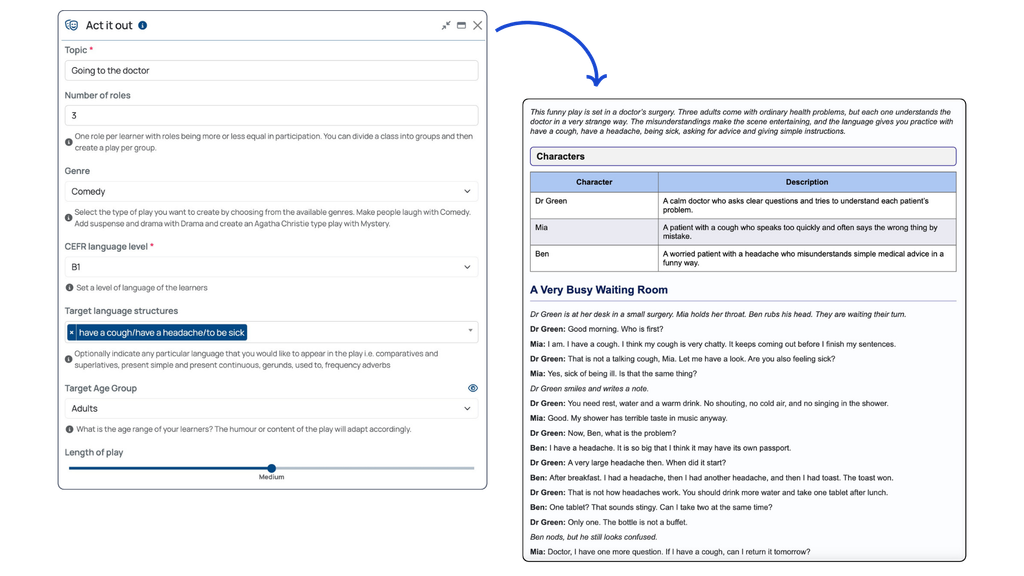
Pilar began by demonstrating how TeacherMatic’s ‘Act it out’ generator lets teachers create scripts for learners to perform in class.
She chose ‘Going to the Doctor’ as her topic, explaining that while this is a realistic and useful everyday situation, learners may not be familiar with the vocabulary if they haven’t experienced it themselves. A scripted performance allows them to explore this language in context and practise communicating in situations they may encounter in real life.
But why not make the experience more entertaining? To bring some humour into the classroom, Pilar selected comedy as the genre, creating a B1-level scenario for three characters aimed at adult learners. She also included target expressions such as ‘have a cough’, ‘have a headache’ and ‘to be sick’, ensuring the activity reinforced relevant vocabulary.
To balance meaningful practice with keeping learners engaged, Pilar chose a medium-length script, with an introductory text to establish context and teacher notes to guide the activity.
From Script to Speaking
With just a few selections, Pilar generated a complete classroom resource, including character descriptions, a script, teacher notes, useful words and expressions and suggestions for additional activities.
The script brought the doctor’s appointment to life through humour, exaggeration and misunderstandings. Beyond making the activity entertaining, Pilar explained how teachers could use the dialogue to reinforce familiar vocabulary in a new context, while helping learners practise pronunciation, intonation and question-and-answer patterns.
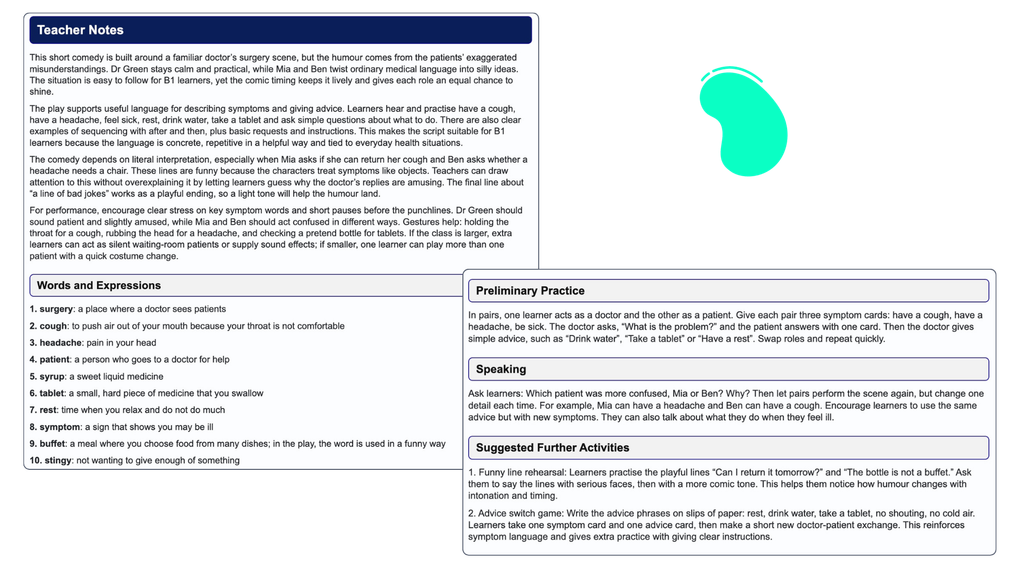
The accompanying teacher notes offered guidance on these areas, while the glossary of useful expressions could be introduced before the performance or shared with learners as they worked through the script.
Pilar also highlighted an interesting opportunity for cultural discussion. Would learners understand why a particular exchange was funny? Would the same situation be considered humorous in their own country? These questions could turn a simple performance into a wider classroom conversation about language, culture and interpretation.
One Script, Multiple Learning Opportunities
‘That’s the great thing about this generator; there is a lot we can do with a single output.’
Rather than treating the generated script as a standalone activity, Pilar explored the suggested further activities, which show how teachers could extend the lesson through additional speaking tasks.
For example, learners could take part in a ‘Sentence Swap’, replacing symptoms in the dialogue to practise familiar vocabulary in different situations. Alternatively, a ‘Funny Ending’ challenge could encourage them to create their own conclusion, drawing on their understanding of the characters, context and humour.
These activities allow teachers to move beyond simply performing the script, encouraging learners to experiment with language and contribute their own ideas.
Importantly, Pilar reminded participants that teachers know their learners best. They can decide which activities are appropriate, adapt the materials to their teaching objectives or regenerate the output if something needs changing.
Bringing Creative Performances into the Classroom
Drawing on her own classroom experience, Pilar shared how she has used ‘Act it out’ with different topics and groups of learners.
One example involved a family trying to catch a train, where confusing tickets, signs and travel arrangements created a series of humorous misunderstandings. For this activity, Pilar selected four characters to allow learners to work together in groups.
As with the doctor’s appointment scenario, the generator provided character descriptions, useful expressions, teacher notes and additional activities, giving Pilar the flexibility to decide how best to use the materials with her students.
These examples illustrated how humour, relatable scenarios and collaborative performances can create opportunities for learners to practise familiar language in new contexts.
Taking Speaking Practice Further
While scripted performances provide valuable opportunities to develop vocabulary, pronunciation and intonation, Pilar wanted to take her learners a step further and encourage them to produce language more independently.
However, moving from rehearsed dialogue to spontaneous communication isn’t always straightforward. Learners may recognise vocabulary and understand individual sentences but still struggle to begin or sustain a conversation.
As Pilar explained, students may find themselves thinking, ‘I don’t know what to say’ or ‘I can’t come up with ideas’.
To address this challenge, she introduced another TeacherMatic generator: ‘Information-gap role play’, designed to support conversations in which learners exchange information, respond to one another and work towards a shared communication goal.
Encouraging More Independent Communication
Unlike scripted performances, TeacherMatic’s ‘Information-gap role play’ generator creates activities where each learner has a unique role, objective and information to share. This encourages learners to think on the spot, respond to their classmates and use language more independently.
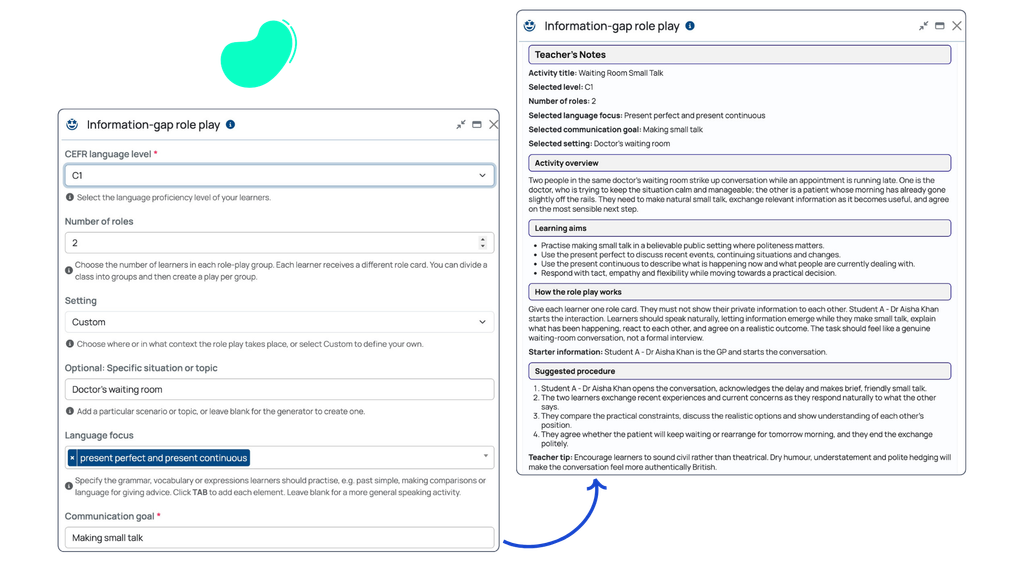
Continuing with the same B1 class, Pilar selected two roles, allowing learners to work in pairs and creating a quieter classroom environment where they could focus on their conversations.
The generator offers a variety of settings, from hotels, shops and cafés to travel scenarios and even mysteries. However, Pilar opted for a custom setting to build on the previous activity: a doctor’s waiting room.
Learners may already know how to describe symptoms or speak to a doctor, but what about making small talk with another patient while waiting? These everyday interactions can be surprisingly challenging and offer valuable opportunities to practise communication.
To develop this scenario, Pilar selected the present perfect and present continuous as the language focus and specified ‘making small talk’ as the communication goal.
By establishing a clear objective, teachers can give learners a sense of direction while still challenging them to formulate their own responses, ask questions and apply familiar language in a different context.
From Role Cards to Real Conversations
With her selections complete, Pilar generated a structured role-play activity featuring two patients making small talk in a doctor’s waiting room.
The output included an activity overview, learning aims, individual role cards, suggested conversation flows and useful language.
Reviewing the activity, Pilar highlighted how everyday conversations, such as making small talk, are often overlooked in traditional coursebooks, despite being an important part of communicating in another language.
‘This [small talk] is something students need to work on and practice. This is something that’s not usually included in coursebooks. It’s a very nice thing to work on.’
The activity’s learning aims focus on practising communication in a realistic setting, asking follow-up questions and maintaining a polite conversation. Rather than relying on a prepared script, learners would need to draw on the information provided and develop the conversation together.
Supporting Learners While Encouraging Independence
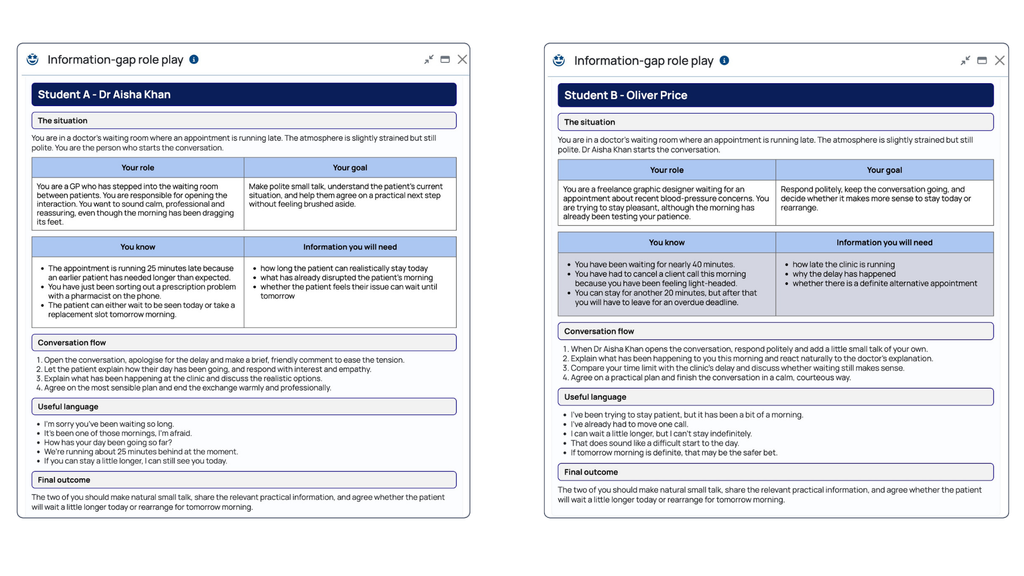
Each learner receives an individual role card outlining their situation, objective, what they already know and the information they need to find out from their partner.
Pilar explained how students could first read through their role cards privately, giving them time to understand their character and prepare for the interaction.
For learners who might feel overwhelmed or unsure how to begin, the generator also provides suggested conversation flows and useful expressions. Teachers can introduce these beforehand, allowing learners to decide which phrases might help them during the activity.
The resource also outlines an intended final outcome, giving learners a clear purpose for their conversation without prescribing exactly what they should say.
However, Pilar emphasised that teachers remain in control of how much guidance learners receive. Depending on their confidence and ability, teachers might share the complete role cards or provide only the situation and communication goal.
‘It’s up to us; we’re the teachers.’
For convenience, each role is organised on a separate page, making the materials easy to print or distribute without additional formatting.
Enhancing Creativity and Collaboration in the Classroom
Beyond the doctor’s waiting room, Pilar shared other examples of how she has used ‘Information-gap role play’ to introduce different language structures and encourage more creative interactions.
For a group of A2 learners, Pilar selected a mystery setting and generated a ‘whodunnit’ activity, creating opportunities to practise language through clues, questions and collaborative problem-solving. Rather than creating an investigation scenario from scratch, she could provide learners with different roles and information, encouraging them to communicate as they worked through the mystery.
She also demonstrated another variation of the doctor’s waiting room scenario, where learners had to negotiate and agree on the order in which patients should see the doctor.
This introduced a different communication challenge. Learners needed to explain their symptoms clearly, listen to one another, justify their reasoning and reach a shared decision.
Pilar particularly appreciated the variety the generator offered. Regenerating an activity could produce new scenarios and conversational challenges, giving teachers opportunities to explore different approaches with the same language focus.
Reflecting on the resources and the enjoyment they can bring to classroom activities, Pilar reminded the attendees that ‘We have everything we need to have a great time with our learners.’
For Pilar, this is important: access to creative, adaptable activities lets teachers spend less time developing scenarios from scratch and more time participating in the learning process with their students, finding joy in the process too.
Bringing Confidence, Creativity and Enjoyment into Speaking Practice
Reflecting on her classroom experiences, Pilar highlighted how these creative activities encouraged learners to participate, collaborate and practise language in meaningful contexts, while bringing more enjoyment into lessons.
‘I really recommend checking out these generators, because the outputs are really useful, engaging and fun. I think students are going to have a great time!’
While traditional coursebooks provide valuable structure and guidance, Pilar highlights an important advantage of TeacherMatic: personalisation. TeacherMatic allows teachers to create activities that reflect their learners’ interests, language levels and specific learning needs.
Explore TeacherMatic for Language Teaching
TeacherMatic’s purpose-built AI tools can support teachers’ creativity and professional judgement, giving them greater flexibility to design speaking opportunities that are relevant, enjoyable and responsive to their learners.
Next in the Webinar Series
Does AI have a role in assessment and language teaching?
Join our expert panel for a special end-of-year Language Teaching Takeoff Webinar, exploring the opportunities, challenges and responsibilities of using AI in language assessment.
Language Teaching and Assessment in the Age of AI: A Panel Discussion
🗓 Thursday, 10th December
🕛 12:00-13:00 GMT (13:00-14:00 CET)
Meet our panellists:
- Nik Peachey, Educator, Author and Edtech Consultant
- Pilar Capaul, Language Teacher and ELT Content Creator
- Joanna Szoke, Teacher Trainer and AI in Education Specialist
- David Moxon, Learning Technology Specialist and Content Developer, Avallain
Together, they’ll share their perspectives on responsible AI use in assessment and feedback, including the role of teacher oversight, AI safeguards and pedagogical quality.
About Avallain
For more than two decades, Avallain has enabled publishers, institutions and educators to create and deliver world-class digital education products and programmes. Our award-winning solutions include Avallain Author, an AI-powered authoring tool, Avallain Magnet, a peerless LMS with integrated AI, and TeacherMatic, a ready-to-use AI toolkit created for and refined by educators.
Our technology meets the highest standards with accessibility and human-centred design at its core. Through Avallain Intelligence, our framework for the responsible use of AI in education, we empower our clients to unlock AI’s full potential, applied ethically and safely. Avallain is ISO/IEC 27001:2022 and SOC 2 Type 2 certified and a participant in the United Nations Global Compact.
_
Contact:
Daniel Seuling
VP Client Relations & Marketing