8 min read
2026/10/22
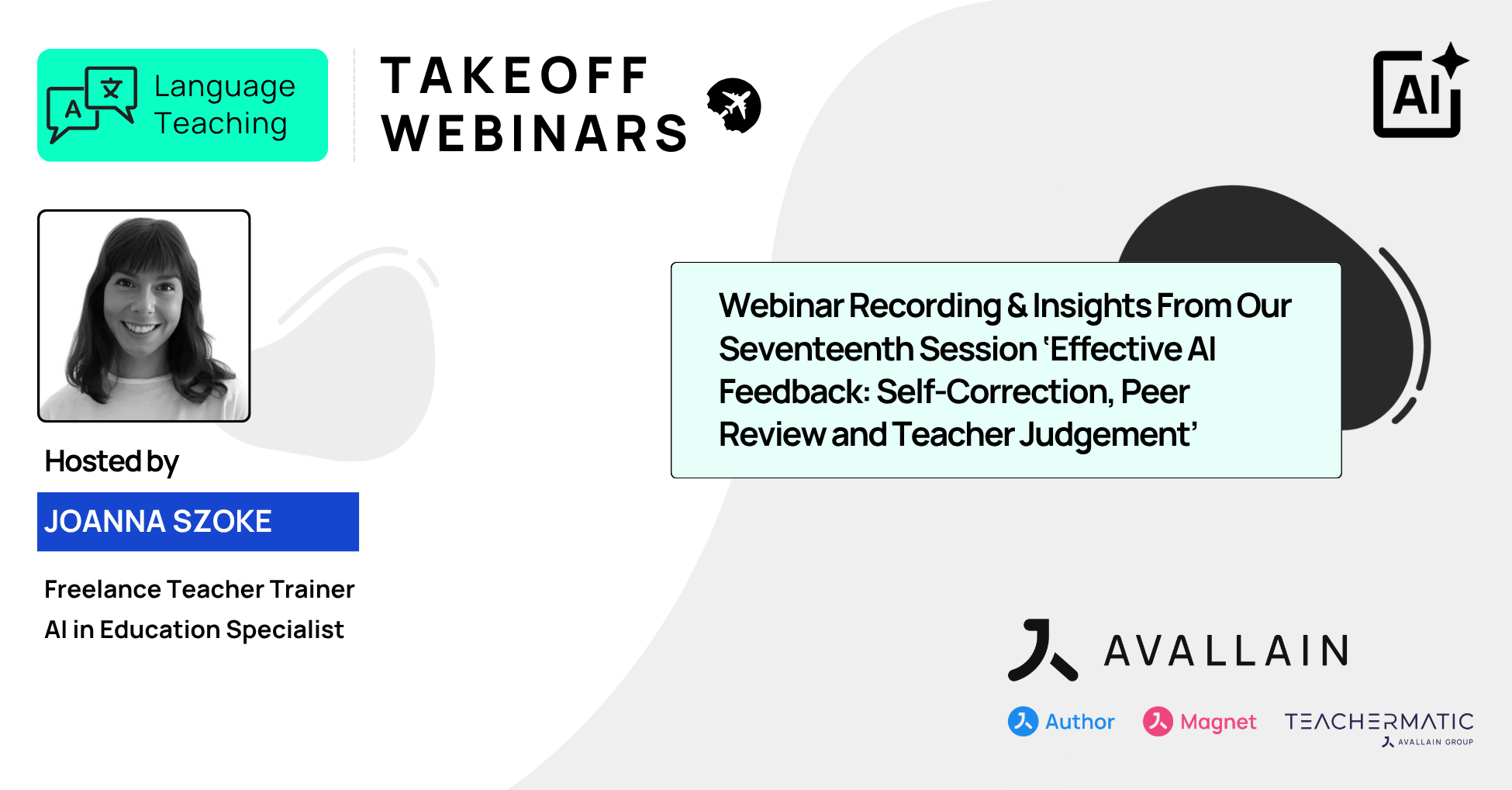
The latest Language Teaching Takeoff Webinar welcomed back freelance teacher trainer and AI in education specialist Joanna Szoke to explore how self-assessment, peer review and teacher feedback can work together to make writing assessment more active, reflective and beneficial for learners.
Building More Reflective, Collaborative Writing Lessons with Purpose-Built AI
London, October 2026 – In ‘Effective AI Feedback: Self-Correction, Peer Review and Teacher Judgement’, Joanna Szoke explored how teachers can combine product and process approaches to writing, giving learners opportunities to analyse models, review their own work, learn from their peers and act on feedback before the teacher’s final assessment.
Moderated by Alba Melián, Marketing and Sales Operations Consultant at Avallain, the session also highlighted the value of using purpose-built AI critically. Through the ‘Model Answer’ and ‘Advanced Feedback’ generators in TeacherMatic for Language Teaching, Joanna showed how teachers can introduce AI into writing assessment without losing sight of pedagogy. This sequence gives learners opportunities to question, compare and reflect on different forms of feedback.
The Thinking Behind Teaching Writing
Joanna began by asking attendees to describe how they approach teaching writing. She asked: How do you teach writing? Do you enjoy it? Do you follow a particular method, or sometimes avoid it altogether?
The responses reflected a range of approaches, from product and process writing to model texts and short, regular writing tasks designed to reduce hesitation and build confidence. As one attendee put it, ‘writing is thinking.’
Joanna agreed, preferring to move beyond simply asking learners to ‘keep practising’. She highlighted the value of giving learners opportunities to analyse examples, notice useful language and structure, organise ideas, respond to feedback and improve through revision.
Joanna then explored where AI can add value within that process. Rather than replacing established teaching approaches, it can support them. Unlike generic AI, TeacherMatic for Language Teaching is designed specifically for language teaching. Teachers can work with established methodologies such as Communicative Language Teaching, the Lexical Approach and Task-Based Learning, responsibly bringing AI into their practice in a way that reflects their teaching context and preferred approach.
Product and Process Approaches to Writing
Joanna then compared two established approaches to teaching writing: the product approach and the process approach.
With a product approach, learners begin with a model text. They analyse its structure and language, often through text mining, to identify useful expressions and patterns they can draw on in their own writing. They then produce a similar text and compare their work with the model.
The process approach focuses on how the writing develops. Learners brainstorm, organise ideas, create drafts, receive feedback and revise, with feedback and reflection built into the process.
Joanna stressed that neither approach is inherently better. Their value depends on the context and the learning aim. A process approach can be especially useful when the aim is to develop thinking, reflection and critical engagement with writing. A product approach may work particularly well in areas such as business language, where learners need to understand the conventions of a specific text type.
Building on the product approach, Joanna next explored how a dedicated AI tool can create model answers for learners to analyse and respond to.
Creating Model Answers with Purpose-Built AI
The ‘Model Answer’ generator allows teachers to create examples that reflect the task, level and learner context rather than relying on a generic prompt.
For her example, Joanna selected an email task, added instructions including the required word count and set the CEFR level to B1. She also added details about the learner profile, including an interest in extreme sports, and uploaded the original textbook email as supporting material for the generator to reference.
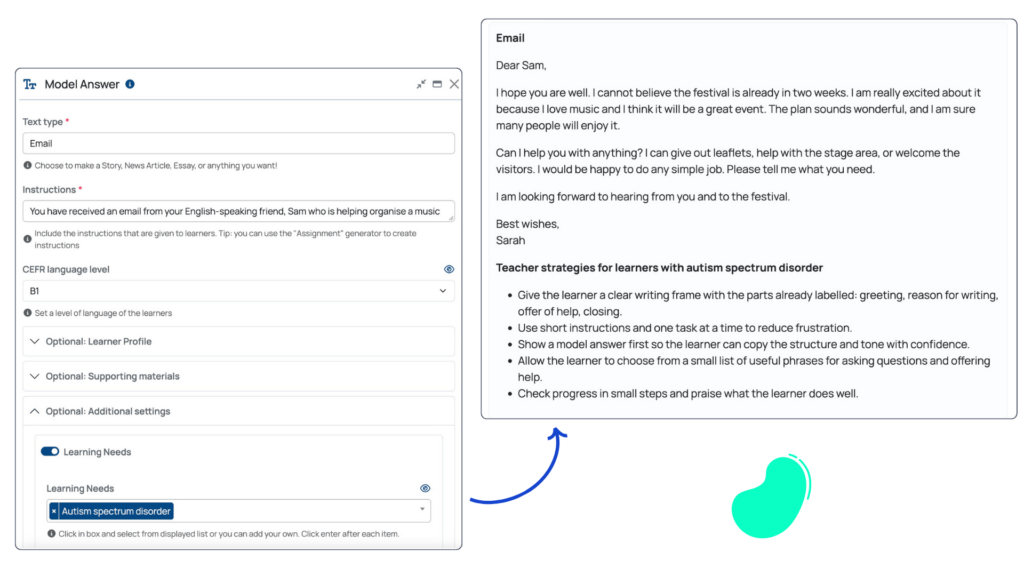
Additional settings let teachers account for specific learning needs. Joanna showed how the generator can provide teaching tips for learners with autism or dyslexia, offering practical suggestions that teachers can consider when planning how to use the model in class.
Once the model answer has been generated, Joanna emphasised the importance of reviewing the output carefully, checking that it follows the task instructions, word count and intended level before using it with learners.
She also highlighted options to refine the result, save it or download it for further use.
But, as Joanna stressed, the value of a model answer lies not simply in generating it, but in how teachers use it with learners.
Using Model Answers in the Classroom
Shifting the focus, Joanna moved from generating a model answer to how to use it in practice. Rather than treating the model as an end point, she showed how teachers can combine elements of the product and process approaches by building rounds of reflection and feedback around it.
She asked attendees to consider the order in which students, peers and teachers should contribute feedback. Joanna noted that this can depend on the teaching context and culture, but highlighted the value of asking learners to assess their own work before moving into peer review.
For peer feedback, she recommends practical approaches such as checklists or colour coding. Learners might identify features such as grammar, spelling or structure using different colours, with the emphasis on noticing rather than simply correcting.
The teacher then steps in to address recurring or more complex issues, clarify points of uncertainty and, where useful, bring common areas of difficulty into wider classroom discussion.
Joanna then showed how teachers can use TeacherMatic to extend this sequence, supporting the teacher’s final review while keeping feedback connected to the learner’s earlier reflection and peer input.
Taking Feedback Further with the ‘Advanced Feedback’ Generator
Joanna then demonstrated the ‘Advanced Feedback’ generator, which allows teachers to upload multiple submissions and apply either Cambridge-aligned or their own assessment criteria. She recommended obtaining student consent before uploading work.
Teachers can add assignment details, upload typed or handwritten work and choose between different feedback formats, including annotated and comparative feedback.
Joanna showed how the generator produces an overview of the feedback, including suggested marks and grades, alongside a teacher report that can be reviewed and edited. The feedback is also broken down by assessment criteria, with a rationale for each mark, followed by top tips, action points and suggested follow-up activities tailored to the individual submission.
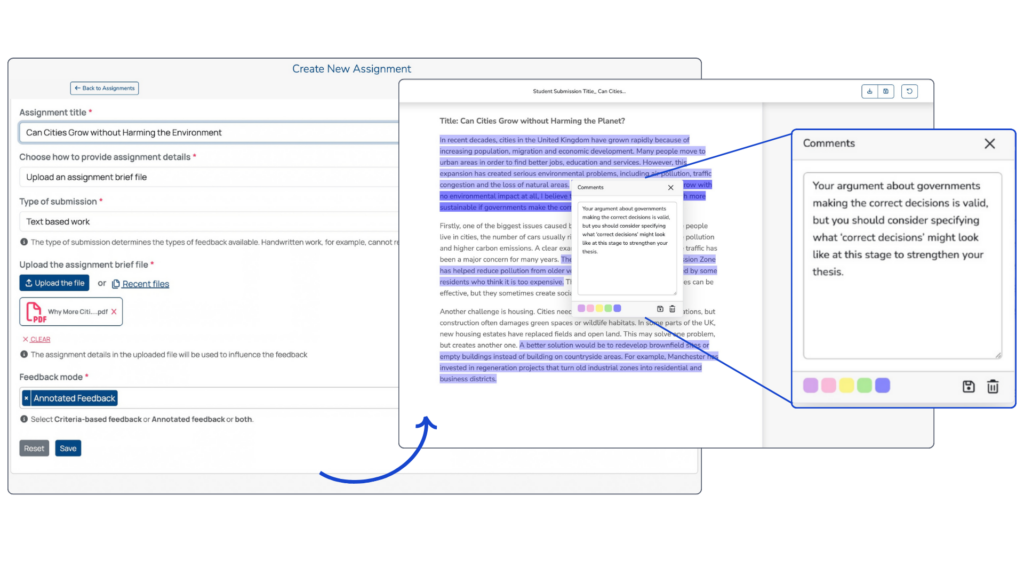
She also demonstrated the annotated feedback option, which is designed to guide learners towards improvements rather than simply rewrite their work for them.
Throughout, Joanna emphasised that the generator should remain part of a teacher-led process, with teachers reviewing the output and deciding how best to use it with each learner.
For a deeper look at the ‘Advanced Feedback’ generator, watch Joanna’s earlier webinar dedicated specifically to this AI tool.
Bringing the Full Feedback Sequence Together
To round off the session, Joanna brought the different stages together into one practical task sequence:
- The teacher generates a model answer.
- Learners analyse the model, noticing features such as structure, syntax and useful language.
- Learners produce their own text.
- They complete a peer review using approaches such as a checklist or colour coding.
- The teacher uses the ‘Advanced Feedback’ generator to support individual feedback.
- Learners compare the teacher feedback with peer feedback and their own earlier reflections.
This comparison gives learners a broader view of their work and creates opportunities to develop AI literacy alongside writing skills. By considering where AI-supported, peer and teacher feedback align or differ, learners can think more critically about feedback rather than simply accepting it.
The teacher remains central to this process, helping learners interpret feedback, clarify questions and identify which points matter most for their individual goals.
Taken together, the approach encourages critical thinking, active learning and a stronger understanding of how to use feedback for improvement, bringing human judgement and AI support into one coherent writing assessment process.
Explore TeacherMatic for Language Teaching
From creating CEFR-aligned model answers and classroom activities to structuring assessment, feedback and follow-up tasks, TeacherMatic for Language Teaching is designed around recognised language teaching methodologies and developed with input from organisations including the International House World Organisation, NILE, Eaquals and English UK.
Purpose-built for language teaching, the AI toolkit supports teachers in bringing AI into established pedagogical approaches while maintaining control over how outputs are reviewed, adapted and used with learners.
Next in the Webinar Series
Join Pilar Capaul, language teacher and ELT content creator, for the next Language Teaching Takeoff Webinar. She will demonstrate the ‘Act it out’ generator and the new ‘Information-gap role play’ generator, showing how teachers can create CEFR-aligned speaking activities that encourage natural communication, collaboration and confidence.
Creative Speaking Activities: Practical AI Tools for Everyday Language Teaching
🗓 Thursday, 12th November
🕛 12:00-12:30 GMT (13:00-13:30 CET)
You’ll see practical ideas for turning language practice into purposeful interaction, from role-play and information exchange to problem-solving and shared goals.
About Avallain
For more than two decades, Avallain has enabled publishers, institutions and educators to create and deliver world-class digital education products and programmes. Our award-winning solutions include Avallain Author, an AI-powered authoring tool, Avallain Magnet, a peerless LMS with integrated AI, and TeacherMatic, a ready-to-use AI toolkit created for and refined by educators.
Our technology meets the highest standards with accessibility and human-centred design at its core. Through Avallain Intelligence, our framework for the responsible use of AI in education, we empower our clients to unlock AI’s full potential, applied ethically and safely. Avallain is ISO/IEC 27001:2022 and SOC 2 Type 2 certified and a participant in the United Nations Global Compact.
_
Contact:
Daniel Seuling
VP Client Relations & Marketing