6 min read
2026/05/21
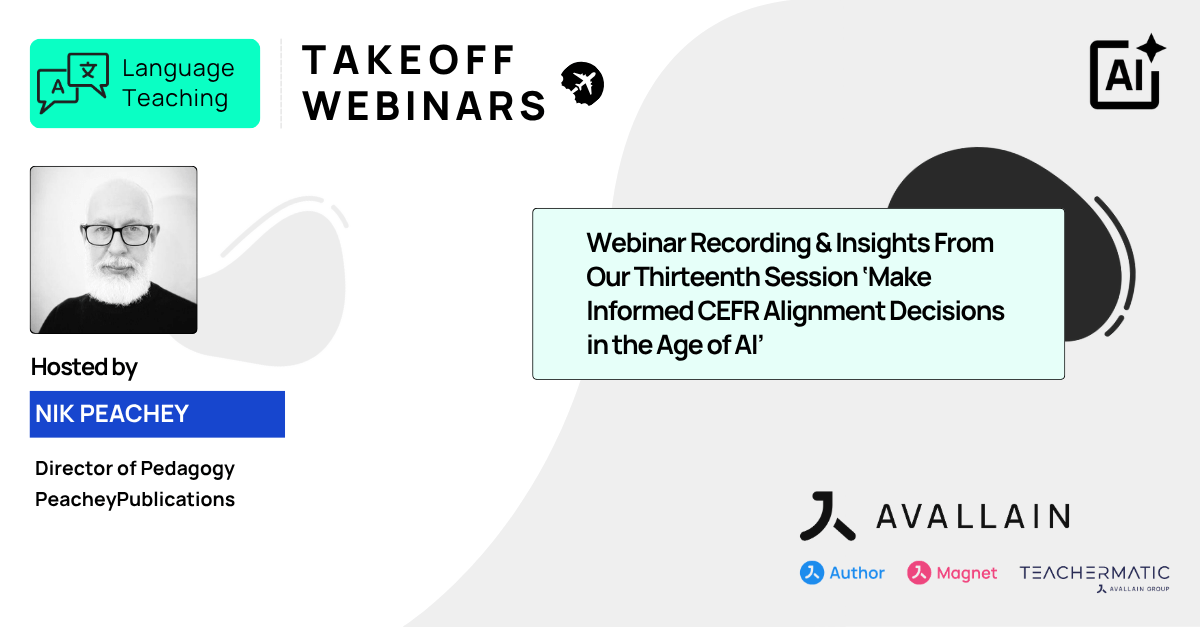
The latest Language Teaching Takeoff webinar welcomed back award-winning educator and edtech specialist Nik Peachey, who explored how language educators can make more informed CEFR alignment decisions using practical resources and purpose-built AI tools designed specifically for language teaching.
Applying CEFR Principles in Practice with TeacherMatic and the New CEFR Alignment Course
London, May 2026 – In ‘Make Informed CEFR Alignment Decisions in the Age of AI,’ Nik introduced the new free ‘CEFR Alignment for Teachers: In the Age of AI’ course and demonstrated how teachers can use TeacherMatic to create, adapt and evaluate CEFR-aligned content while maintaining professional judgement.
Moderated by Giada Brisotto, Senior Marketing and Sales Operations Manager at Avallain, the session focused not only on strengthening teachers’ understanding of CEFR principles, descriptors and benchmarking, but also on applying that knowledge in practice through dedicated AI generators designed for language education.
Why Generic AI Does Not Always Meet CEFR Alignment Needs
Passionate about using technology to support both teachers and learners, Nik Peachey opened the session by acknowledging the growing role AI can play in language education. However, he also made a clear distinction between generic AI tools and solutions designed specifically for language teaching.
For Nik, the challenge with CEFR alignment is precision. The CEFR is not simply a set of levels to select from, but an outcomes-based framework built around descriptors, language skills and learner performance. Accurate alignment requires interpretation, context and professional judgement.
This is why Nik highlighted the value of specialised AI toolkits such as the TeacherMatic Language Teaching Edition. With dedicated language teaching AI tools, CEFR alignment is a central consideration. Rather than relying on broad, generic outputs, these pre-programmed AI generators are designed to align with framework descriptors and intended learning outcomes, empowering educators to create, adapt and evaluate framework-based materials with greater confidence.
Practical CEFR Resources for More Confident Decision Making
Recognising that informed CEFR alignment depends on informed teacher judgement, Nik introduced the new free CEFR alignment for teachers course as a practical resource for educators looking to strengthen their understanding of the framework.
Developed in collaboration with the Norwich Institute for Language Education (NILE) and delivered on Avallain Magnet, the interactive course is designed to be flexible and easy to navigate, allowing educators to move at their own pace, assess their progress and build confidence in applying CEFR principles more effectively.
As Nik noted, the CEFR overview and foundational quiz offer a useful reality check, helping educators assess what they already know before progressing into deeper CEFR concepts and practical application.
An Interactive Approach to CEFR Alignment
Nik then walked attendees through the course itself, highlighting its practical, flexible design and immediate relevance for language educators working with CEFR.
As Nik demonstrated, the course goes beyond theory, allowing educators to engage directly with the CEFR framework. Participants can explore how descriptors differ across levels from A1 to C2, examine the defining features of each scale and strengthen their understanding of how language proficiency is described in practice.
One particularly valuable area Nik highlighted was mediation, now recognised as a fifth skill area alongside reading, writing, listening and speaking. The course allows educators to explore how learners communicate understanding, negotiate meaning and bridge communication gaps, areas that are becoming increasingly important in modern language teaching.
Interactive activities encourage educators to work directly with descriptors, assess whether tasks align above or below a chosen level and strengthen their ability to benchmark materials more accurately, including distinctions within the often more nuanced ‘plus’ levels.
Nik described the course as a particularly valuable resource for educators involved in CEFR teaching, benchmarking and assessment, helping build the confidence needed for more accurate, informed decision-making.
From Understanding to Practical Content Creation with TeacherMatic
With the foundations of CEFR alignment established, Nik then demonstrated how that knowledge can be applied in practice using the TeacherMatic Language Teaching Edition.
Designed specifically for language educators, TeacherMatic’s AI generators are built around CEFR-informed, outcomes-based principles. This enables teachers to create materials aligned to learner levels and specific teaching contexts.
Nik demonstrated the ‘Create a Text’ generator, using the example of a sustainability-focused news article aligned to a C2 proficiency level. Educators can define learner profiles, in this case adults, alongside optional supporting materials and additional learner needs to shape outputs more precisely.
Nik highlighted the generator’s flexibility. Rather than accepting an output as final, teachers can further enhance and adapt the content using the ‘Refine’ feature, whether by introducing target vocabulary, adjusting complexity or incorporating short dialogue to suit a specific teaching context better.
Adapting Content for Different CEFR Levels
Nik then demonstrated how the same content could be adapted for a completely different level of learning using the ‘Adapt your Content’ generator.
Using the previously generated C2 sustainability article, he selected the option to align the content with A2 learners, with a secondary learner profile. The result was a noticeably simplified version, with shorter sentences, more accessible vocabulary and content more appropriate for learners at that proficiency stage.
As with the earlier example, refinement remains an important part of the process. Teachers can continue adjusting outputs, learner needs or language goals.
Nik also suggested the ‘CEFR Level Checker’, particularly when working with self-created content. By checking whether a text aligns with the intended CEFR level, educators can make more informed decisions before bringing materials into the classroom.
Stronger CEFR Alignment Starts with Better Foundations
The CEFR remains one of the most widely adopted frameworks in language education, but effective alignment depends on more than selecting a level or generating content that appears appropriate on the surface. Inconsistent interpretation or inaccurate application can impact the quality of learning materials and, ultimately, learner progress.
As Nik demonstrated in this session, combining strong professional knowledge with practical resources and purpose-built AI tools gives educators a far more confident and effective way to approach CEFR alignment.
With interactive learning resources such as the CEFR alignment course and dedicated TeacherMatic AI tools, educators are better equipped to create, adapt and evaluate materials that genuinely reflect learner needs, supporting more meaningful progression, clearer communication and stronger learning outcomes.
Register for the Free CEFR Alignment Course
Strengthen your understanding of CEFR principles with this free, interactive course, designed to build confidence in interpreting descriptors, benchmarking learners and making more informed alignment decisions.
Explore the TeacherMatic Language Teaching Edition
The TeacherMatic Language Teaching Edition includes dedicated CEFR-aligned AI generators to support the creation, adaptation and evaluation of language teaching materials across different learner levels and contexts. Educators can adopt AI safely and responsibly while maintaining full professional control.
Next in the Webinar Series
Boost Learner Confidence with Engaging, Targeted IELTS-Style Practice Materials
🗓 Thursday, 11th June
🕛 12:00 – 12:30 BST (13:00 – 13:30 CEST)
Join Joanna Szoke, freelance teacher trainer and AI in education specialist, for the next Language Teaching Takeoff Webinar.
See how TeacherMatic’s ‘IELTS Style Test Prep Generator’ can support more efficient creation of adaptable IELTS practice materials while strengthening learner preparation.
About Avallain
For more than two decades, Avallain has enabled publishers, institutions and educators to create and deliver world-class digital education products and programmes. Our award-winning solutions include Avallain Author, an AI-powered authoring tool, Avallain Magnet, a peerless LMS with integrated AI, and TeacherMatic, a ready-to-use AI toolkit created for and refined by educators.
Our technology meets the highest standards with accessibility and human-centred design at its core. Through Avallain Intelligence, our framework for the responsible use of AI in education, we empower our clients to unlock AI’s full potential, applied ethically and safely. Avallain is ISO/IEC 27001:2022 and SOC 2 Type 2 certified and a participant in the United Nations Global Compact.
_
Contact:
Daniel Seuling
VP Client Relations & Marketing