6 min read
2026/02/19
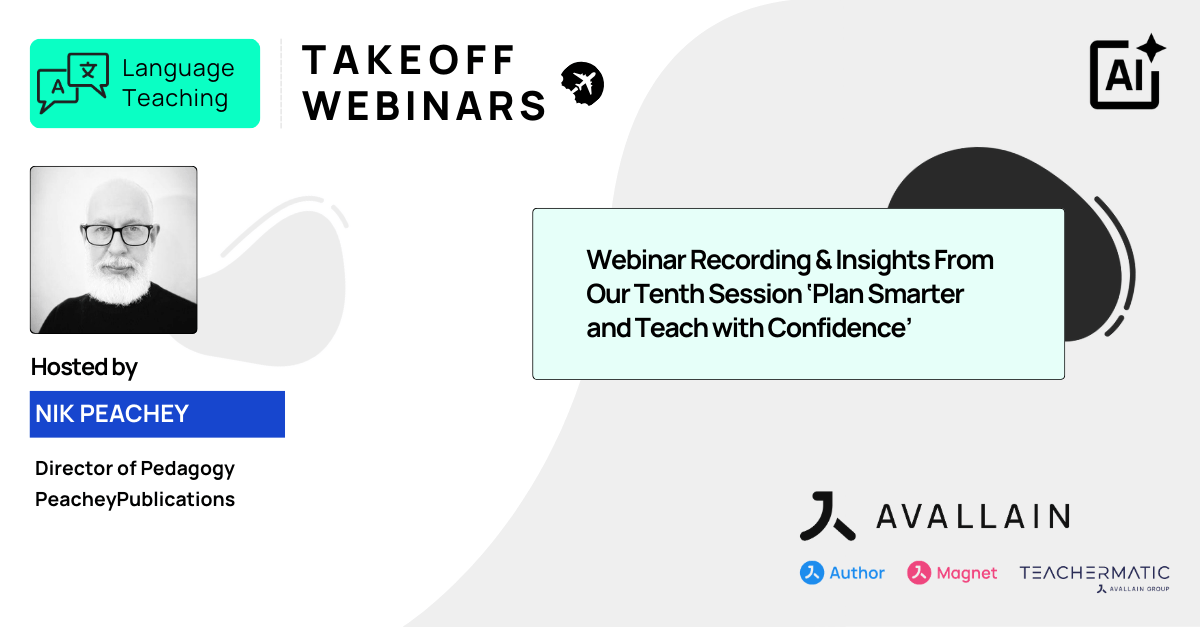
The latest Language Teaching Takeoff webinar welcomed back educator and edtech specialist Nik Peachey, who explored how the TeacherMatic Language Teaching Edition can support the full cycle of planning: from course design to detailed lesson preparation, through to meaningful lesson wrap-ups that reinforce learning.
Plan a Comprehensive and Impactful Course with TeacherMatic
London, February 2026 – In ‘Plan Smarter and Teach with Confidence,’ Nik focused on course planning and its often time-intensive components. He demonstrated how teachers, academic managers and directors of studies can use TeacherMatic’s AI generators, including the ‘Scheme of Work / Curriculum Plan’ generator, to support this work while maintaining professional control.
Moderated by Giada Brisotto, Senior Marketing and Sales Operations Manager at Avallain, the session focused not only on planning but on developing it in greater detail, from course design through to fully structured lessons and effective wrap-ups.
Before Planning a Course
Nik began by acknowledging the time-intensive nature of developing effective courses. He emphasised the importance of reducing repetitive preparation, building clear planning structures and aligning content with learner levels. To support this process, TeacherMatic provides AI tools for each stage of course development, enabling teachers to build structured plans while keeping content aligned with the CEFR.
He also demonstrated how generators can be quickly located using simple filter settings. Users can filter by task or role to surface the most relevant tools and favourite the ones they use most often, making the planning process more efficient.
Before moving into the generators themselves, Nik encouraged participants to consider lesson wrap-ups as part of the planning process. This step is often overlooked but plays an important role in reinforcing learning and supporting retention at the end of each lesson.
Creating a Course Plan
Nik opened the demonstration with the ‘Scheme of Work / Curriculum Plan’ generator, showing how users can plan a course for a specific group of learners. Using the Sustainable Development Goals as the course theme, he defined key topics, set the number of sessions to six and selected a table format at the B1 level. Additional details, such as learner age and optional support materials, were added to personalise the course further.
He also selected a pedagogical model, choosing Task-Based Learning, and showed how course creators can receive guidance on learning needs. The result was a clearly structured scheme of work presented in table form, with six session titles and supporting descriptions. Each session followed a task-based framework with pre-task, main task, post-task and wrap-up stages, and concluded with a review and action plan.
Building Out Individual Lessons
Once a course plan is in place, each session needs to be developed in greater detail. A lesson outline alone is rarely sufficient, so the focus shifted to how the ‘Lesson Plan’ generator can expand a single session into a fully structured lesson. Nik demonstrated how to define a topic, clarify lesson aims, and set timing and a pedagogical model, all while keeping the lesson aligned with CEFR levels, skills and subscales.
The generated plan followed a clear, task-based structure. It was organised to include an introduction, main activity, language focus and summary, with suggested resources and homework. This provided a detailed foundation that could be refined and adapted, enabling teachers, academic managers and directors of studies to move from outline to delivery with greater confidence, while reducing preparation time.
Reinforcing Learning as Part of the Plan
The final stage of the workflow focused on lesson wrap-ups. This is an area often overlooked in planning but essential for reinforcing learning and encouraging reflection.
Using the ‘Lesson Wrap-Up’ generator, Nik showed how teachers can set the topic, CEFR level and learner profile, as well as include specific learning needs or supporting materials. The generator then produces a range of structured activities designed to check understanding and prompt reflection. Activities included true-or-false checks, gap fills, discussion prompts and poster creation, which Nik noted was a particularly effective way for learners to reflect while engaging more creatively with the topic.
By building this final stage into the planning process, teachers can close lessons with purpose, allowing learners to review, reflect and retain key language while ensuring that each session connects clearly to the wider course.
From Big Picture to Lesson Reflection
A strong course considers each stage of the teaching process, from the initial structure through to the reinforcement of learning at the end of a lesson. Nik demonstrated how this full workflow can be supported within TeacherMatic, progressing from a course plan to detailed lesson planning and, finally, to lesson wrap-ups that consolidate learning.
With CEFR alignment embedded throughout, teachers can build from the big picture into individual sessions and then use additional generators to create supporting materials. Nik demonstrated how filters, such as ‘Speaking’ and ‘Reading’, can quickly identify relevant tools, enabling teachers to produce resources aligned with lesson objectives. Plans and materials can be saved and shared across a school account, supporting collaboration and reducing duplication.
Together, this structured flow enables teachers, academic managers and directors of studies to plan with greater clarity, maintain professional control and ensure that each lesson contributes meaningfully to the wider course.
Explore the TeacherMatic Language Teaching Edition
For educators seeking greater clarity and consistency in planning, the TeacherMatic Language Teaching Edition provides CEFR-aligned generators to support course design, lesson development, course materials and lesson wrap-ups, with the flexibility to refine and adapt plans across contexts.
Next in the Webinar Series
Inspire, Monitor, Motivate: Practical AI Tools for Everyday Teaching
🗓 Thursday, 12th March
🕛 12:00 – 12:30 GMT | 13:00 – 13:30 CET
Join first-time guest host Pilar Capaul, language teacher and ELT content creator, for a practical session focused on real classroom use cases.
Pilar will demonstrate how two TeacherMatic generators can support everyday teaching by drawing on examples from her own lessons. See how the ‘Did you do your homework?’ generator can be used to check understanding and completion, and how the ‘Inspiration!’ generator can spark motivation and engagement.
About Avallain
For more than two decades, Avallain has enabled publishers, institutions and educators to create and deliver world-class digital education products and programmes. Our award-winning solutions include Avallain Author, an AI-powered authoring tool, Avallain Magnet, a peerless LMS with integrated AI, and TeacherMatic, a ready-to-use AI toolkit created for and refined by educators.
Our technology meets the highest standards with accessibility and human-centred design at its core. Through Avallain Intelligence, our framework for the responsible use of AI in education, we empower our clients to unlock AI’s full potential, applied ethically and safely. Avallain is ISO/IEC 27001:2022 and SOC 2 Type 2 certified and a participant in the United Nations Global Compact.
_
Contact:
Daniel Seuling
VP Client Relations & Marketing