8 min read
2026/08/27
Creating high-quality digital learning content at scale requires efficient editorial workflows that support both productivity and human oversight. In the third session of Avallain’s Product Webinar Series, David Moxon and Stephen Madden explored how Avallain Author supports publishers, schools, institutions and digital learning providers in accelerating editorial production while creating interactive, responsive and accessible learning content across a wide range of educational contexts.
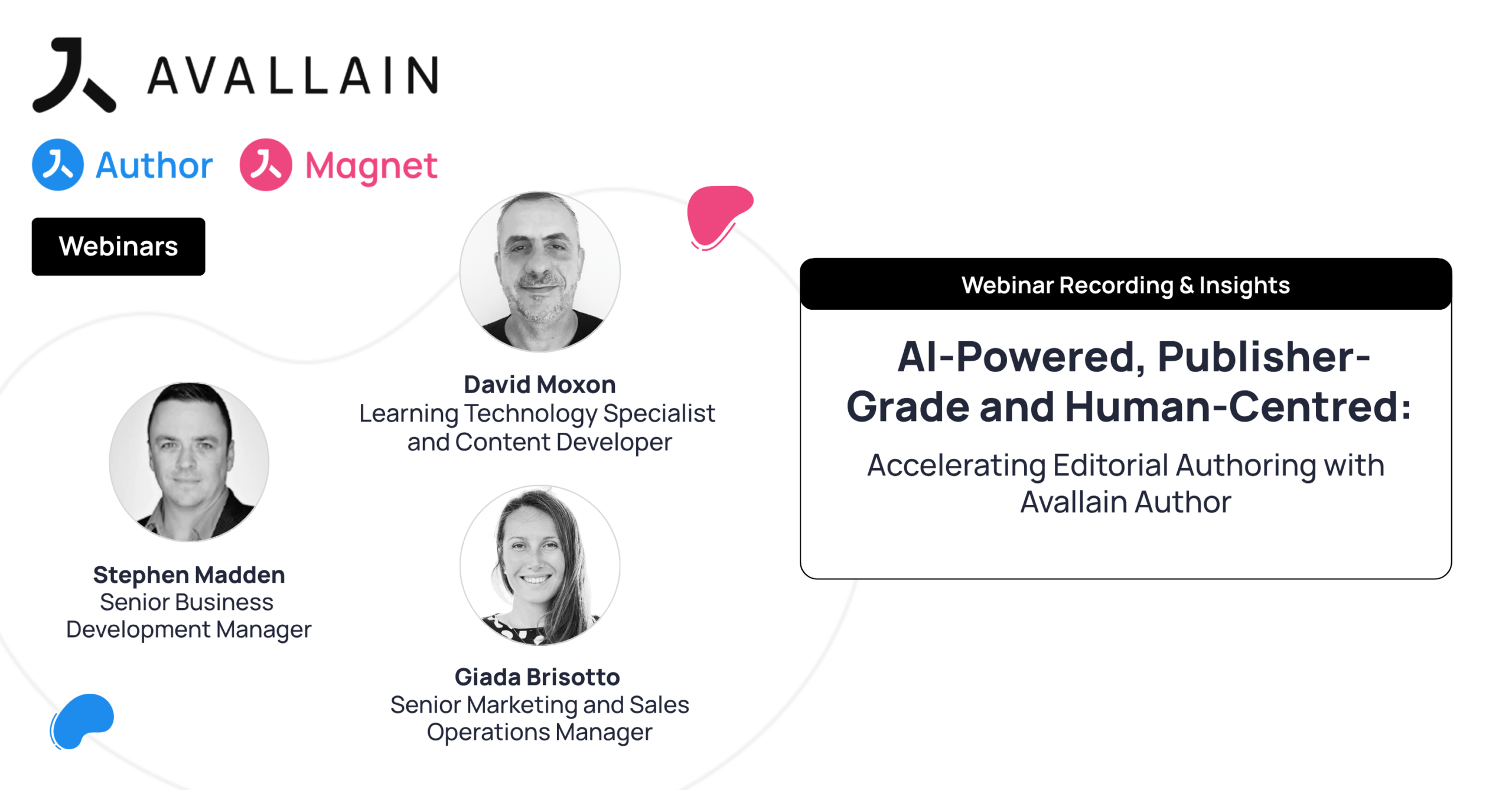
AI-Powered, Publisher-Grade and Human-Centred: Accelerating Editorial Authoring with Avallain Author
St. Gallen, August 2026 –In the third session of Avallain’s Product Webinar Series, ‘AI-Powered, Publisher-Grade and Human-Centred: Accelerating Editorial Authoring with Avallain Author’, David Moxon, Learning Technology Specialist and Content Developer, and Stephen Madden, Senior Business Development Manager, demonstrated how Avallain Author combines content creation and management with AI-powered capabilities to support efficient, publisher-grade editorial workflows.
Moderated by Giada Brisotto, Senior Marketing and Sales Operations Manager, the webinar explored how editorial teams can manage complex content projects, accelerate the creation of learning materials with AI and build highly interactive, responsive and accessible educational experiences for different sectors and learner needs.
Managing Content and Editorial Workflows in One Environment
The webinar opened with a live demonstration of Avallain Author from Stephen, who introduced the platform not only as a content creation tool, but also as a content management environment designed to support structured editorial production.
From the project dashboard, teams can gain an overview of the people working on a project, assigned tasks and different editorial roles. Roles can be configured with specific rights and permissions, helping organisations establish workflows that reflect the way their teams work.
Stephen also introduced the different areas available within a project, including Work Packages, Structures, the Media Library, Reports, Project Settings and Project Activities. Together, these capabilities provide a central environment for creating, organising and managing learning content throughout the production process.
Within Work Packages, teams can manage individual Learning Objects (LOs) and perform actions individually or in bulk, including publishing, copying, renaming and locking content. Metadata can also be added to learning activities, supporting richer analysis once learners begin interacting with the content by categorising it according to areas such as vocabulary, grammar or speaking.
By bringing content production and project management together, Avallain Author enables editorial teams to manage sophisticated digital learning projects without separating the creation process from the workflows surrounding it.
Accelerating Content Creation with AI While Keeping Humans in the Loop
Stephen then demonstrated GenAI in Avallain Author, showing how artificial intelligence can accelerate the first stages of content production without removing editorial control.
Starting with a simple prompt around small talk in a business context, he created a B1-level lesson for adult language learners. The learner profile allowed parameters such as age and CEFR level to be defined, while the author could choose the types of activities to generate and incorporate media where required.
For the demonstration, GenAI created four activities: an introductory presentation, a gap-fill exercise, a linking activity and a crossword. Within approximately a minute, the initial idea was transformed into a structured set of interactive learning activities ready for review and refinement.
Crucially, the workflow did not end with AI generation.
Stephen demonstrated how an editor could immediately review the generated material and make precise changes, whether to align terminology with an editorial style guide, reinforce previously introduced vocabulary or adapt the material to the requirements of a particular course.
This reflected one of the webinar’s central themes: AI can significantly accelerate drafting and production, but human editorial expertise remains essential. Rather than automatically publishing AI-generated material to learners, Avallain Author allows authors and editors to review, adapt and approve content before it reaches the learner.
The Q&A reinforced this approach. The speakers explained that generated content undergoes an initial check for harmful or highly inappropriate material, while editorial validation remains dependent on human review. This human-in-the-loop principle forms an important part of Avallain’s wider approach to the responsible use of AI in education.
Creating Interactive Learning Experiences Across Educational Contexts
David continued the live demonstration by showcasing the breadth of interactive learning content that can be created in Avallain Author.
With more than 50 Activity Types available, Avallain Author supports learning experiences designed for a wide variety of educational contexts rather than limiting authors to a small set of standard interactions.
For language learning, David demonstrated a Dialogue Recording activity in which learners can select a role within a conversation, listen to the other speaker and record their own responses. Once complete, learners can listen back to the entire dialogue, combining the original audio with their own recorded contributions.
He also demonstrated a Pronunciation activity that enables learners to record individual words and receive automated pronunciation feedback. Authors can adjust how feedback is presented and define the level at which pronunciation is considered successful, making the activity adaptable to different learner levels and objectives.
The demonstration then moved across other educational sectors. A K-12 activity used animated elements to help learners sequence the stages of the water cycle, while a STEM example showed how integration with WIRIS enables learners to work with sophisticated mathematical notation, equations and mathematical input.
For vocational learning, a Highlighting activity asked learners to identify different categories of safety information within a workplace procedure.
Together, the examples illustrated how a common authoring environment can support very different pedagogical requirements, from speaking practice and pronunciation to mathematics, sequencing and workplace training.
Responsive and Accessible Learning by Design
The webinar also highlighted how responsiveness and accessibility are embedded into the learning experiences created with Avallain Author.
During the demonstrations, attendees saw how content could be previewed across different device formats, including desktop, tablet and mobile. Activity Types adapt automatically to different screen sizes and, where necessary, can adjust their behaviour to provide an appropriate interaction for the device being used.
This means editorial teams do not need to create separate versions of the same learning activity for different devices.
David also highlighted accessibility across Avallain Author’s Activity Types, including support for screen readers and keyboard navigation. By incorporating these considerations into the content framework itself, publishers and educational organisations can create engaging digital materials while addressing accessibility requirements as an integral part of the production process.
From Digital Books to Richer Learning Experiences
The session concluded with a preview of Avallain Author’s Digital Book capabilities.
David demonstrated how existing PDF materials can be imported into Avallain Author and transformed into a Digital Book that retains the familiar book experience while introducing new layers of interactivity.
Learners can navigate the book, use annotation tools and interact with hotspots placed directly onto its pages. These hotspots can connect the book to interactive Learning Objects, video and audio content, external websites and other pages within the publication.
This approach enables publishers to build on existing book-based materials while connecting them with interactive digital learning experiences, bridging traditional publishing formats and richer course-based learning.
Digital Books and the wider Digital Book Experience will be explored in greater depth in the next session of Avallain’s Product Webinar Series.
Combining Editorial Efficiency with Human Expertise
The webinar demonstrated how Avallain Author brings together the different elements required for modern digital educational publishing: project and content management, AI-assisted creation, sophisticated interactivity, responsive delivery and accessibility.
AI can help editorial teams move rapidly from an initial idea to a first draft of structured learning content. A broad range of Activity Types allows those materials to be transformed into engaging experiences for language learning, K-12, STEM, vocational training and other educational contexts. At the same time, project management and editorial capabilities enable teams to organise, review and control content throughout production.
Most importantly, automation does not replace editorial judgement. Authors and editors remain responsible for reviewing generated content, applying their pedagogical and subject expertise and deciding when materials are ready to be published.
By combining AI-powered efficiency with publisher-grade workflows and human oversight, Avallain Author enables organisations to accelerate digital content production while maintaining the quality, flexibility and control required to create meaningful learning experiences at scale.
Watch the Webinar Recording
Watch the full webinar recording to see Avallain Author in action and discover how its project management, AI-powered content creation and interactive Activity Types can help editorial teams accelerate production while keeping human expertise at the centre of the authoring process.
Continue the Conversation in Our Next Webinar
Our Product Webinar Series continues with the next live session:
Digital Book Experience Courses: Seamlessly Connecting Traditional Books and Interactive Activities with Avallain Author and Avallain Magnet
Hosted by:
- David Moxon, Learning Technology Specialist and Content Developer, Avallain
- Stephen Madden, Senior Business Development Manager, Avallain
Moderated by:
- Giada Brisotto, Senior Marketing and Sales Operations Manager, Avallain
🗓 Wednesday, 23 September 2026
🕒 14:00–14:30 BST | 15:00–15:30 CEST
Through more than two decades of close collaboration with publishers, we’ve seen how digital books have become the backbone of many successful product strategies. In this 30-minute live webinar, we will share innovative ways to enhance these offerings, both commercially and in ways that enrich the learner’s journey.
Go beyond simply delivering books online and expand them into an immersive learning experience with fully interactive activities connected to the book’s material. We will demonstrate how to enhance digital books with Avallain Author and Avallain Magnet. You’ll learn how to add interactive hotspots seamlessly connected to multimedia assets and learning exercises, develop a comprehensive course structure and provide an engaging Digital Book Experience (DBX) course for your learners.
We will guide you through the process of creating a Digital Book from PDF materials in Avallain Author. We’ll show you how to integrate interactive elements via hotspots, organise the DBX course with the Structure Tool and publish it to showcase the final learner experience in Avallain Magnet.
Click below to register and secure your spot.
About Avallain
For more than two decades, Avallain has enabled publishers, institutions and educators to create and deliver world-class digital education products and programmes. Our award-winning solutions include Avallain Author, an AI-powered authoring tool, Avallain Magnet, a peerless LMS with integrated AI, and TeacherMatic, a ready-to-use AI toolkit created for and refined by educators.
Our technology meets the highest standards with accessibility and human-centred design at its core. Through Avallain Intelligence, our framework for the responsible use of AI in education, we empower our clients to unlock AI’s full potential, applied ethically and safely. Avallain is ISO/IEC 27001:2022 and SOC 2 Type 2 certified and a participant in the United Nations Global Compact.
_
Contact:
Daniel Seuling
VP Client Relations & Marketing